Is Law Compatible with Politics? Tunisia Says Yes
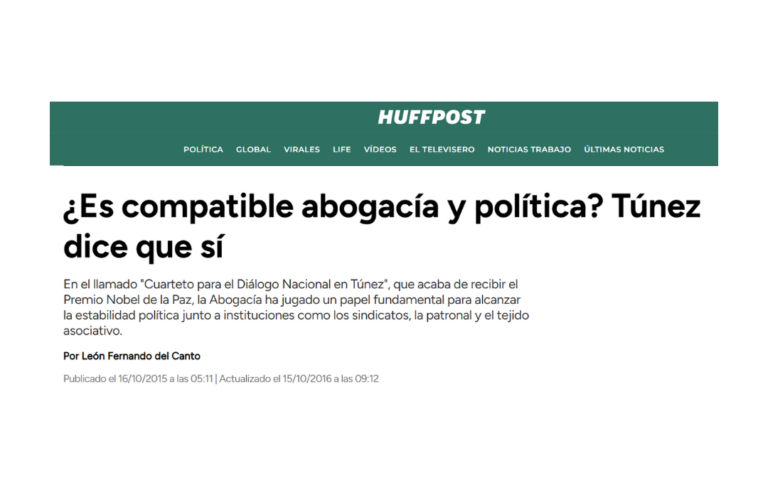
The relationship between the legal profession and politics has long been a subject of debate. In many jurisdictions, lawyers are expected to maintain a strict separation from political life, based on the assumption that political engagement compromises professional independence. Yet this assumption is not universal — and Tunisia offers a compelling counterexample.
By explicitly recognising the compatibility between legal practice and political participation, Tunisia challenges a deeply rooted belief in parts of Europe: that lawyers must remain distant from political institutions to preserve neutrality and credibility.
Law and Politics: An Inevitable Intersection
Law and politics are not parallel worlds; they are structurally interconnected. Laws are created through political processes, interpreted through legal reasoning and applied within institutional frameworks shaped by public policy. To suggest that lawyers can or should be entirely detached from politics is to ignore the reality of how legal systems function.
Lawyers possess technical expertise, constitutional awareness and institutional knowledge that are essential to sound political decision-making. When excluded from political participation, public debate risks losing legal rigour and normative coherence.
The Tunisian Example
In Tunisia, the post-revolutionary legal framework explicitly allows lawyers to hold political office without renouncing their professional status. This model reflects an understanding that legal expertise strengthens democratic institutions rather than undermines them.
The Tunisian approach assumes that professional ethics, transparency and accountability — rather than formal exclusion — are the appropriate safeguards against conflicts of interest. It places trust in institutional maturity rather than in rigid prohibitions.
European Reluctance and Cultural Inertia
In contrast, many European legal systems continue to view political engagement by lawyers with suspicion. This reluctance often stems from historical corporatism and an overly formalistic interpretation of professional independence.
Such rigidity can lead to paradoxical outcomes: lawyers influence political decisions informally, through advisory roles or lobbying, while being formally excluded from open political participation. This disconnect weakens transparency and limits democratic accountability.
Independence Does Not Mean Isolation
Professional independence should not be confused with political isolation. Independence refers to the ability to exercise legal judgement free from undue pressure — not to abstain from public life altogether.
A lawyer engaged in politics does not cease to be a lawyer; rather, they bring legal reasoning, respect for institutional balance and commitment to the rule of law into the political arena. Properly regulated, this engagement can enhance — not erode — public trust.
Safeguards Through Ethics, Not Prohibition
The real challenge lies not in determining whether law and politics are compatible, but in designing ethical safeguards that ensure transparency, accountability and integrity. Clear rules on conflicts of interest, disclosure obligations and professional conduct are more effective than blanket incompatibilities.
Tunisia’s model suggests that democracy benefits when legal professionals are allowed to contribute openly to political life under clear and enforceable ethical standards.