
Is legal practice compatible with international expansion?
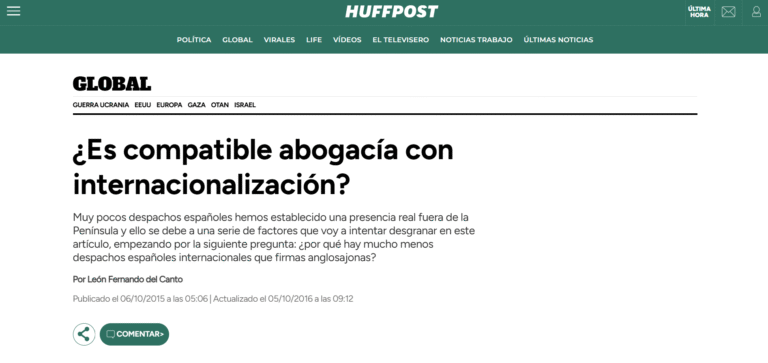
Over recent decades, many Spanish companies have expanded across the Middle East, Africa, Asia and Latin America—creating clear demand for cross-border legal support. Spanish law firms have tried to follow, often via loose alliances with local firms or by subcontracting to large (mostly Anglo-Saxon) practices. Yet only a few Spanish firms have built a real presence abroad. Why are there far fewer international Spanish firms than Anglo-Saxon ones?
Drawing on my own experience opening offices in England and Qatar (and the mistakes made along the way), I see four core challenges for Spanish firms:
-
Commercial international experience. Our lawyers are technically strong and multilingual, but many lack hands-on business development experience across jurisdictions—too often we send excellent technicians without international commercial skills to represent the firm.
-
International and foreign law. Confusing Spanish civil/commercial realities with international practice is common. Comparative law or dictionaries can’t replace training and practice in at least one foreign jurisdiction. To be truly “international,” a lawyer should master at least two systems: one civil-law and one common-law.
-
A lingering colonial mindset. Success abroad requires studying not only local law but also culture and administrative realities. Without this, productive engagement with local counterparts is impossible.
-
Complexes and confidence. Facing Anglo-American teams can be intimidating, but perfect Shakespearean English isn’t required. As a London colleague with a strong Italian accent told me: “My friend, the fact that I speak like a foreigner does not mean that I think like a foreigner.”
A realistic path forward
Emerging markets need everything from institutional strengthening to infrastructure and technology—areas where Spanish business excels. As our companies expand, they expect their counsel to keep pace internationally. The opportunity is there if we recognise the challenges and build on our strengths. Spanish advocacy has the legal capacity and institutional solidity to compete with Anglo-Saxon counterparts—provided we embrace training in foreign laws, deepen commercial skills, shed our complexes, and engage locally with humility and expertise.