
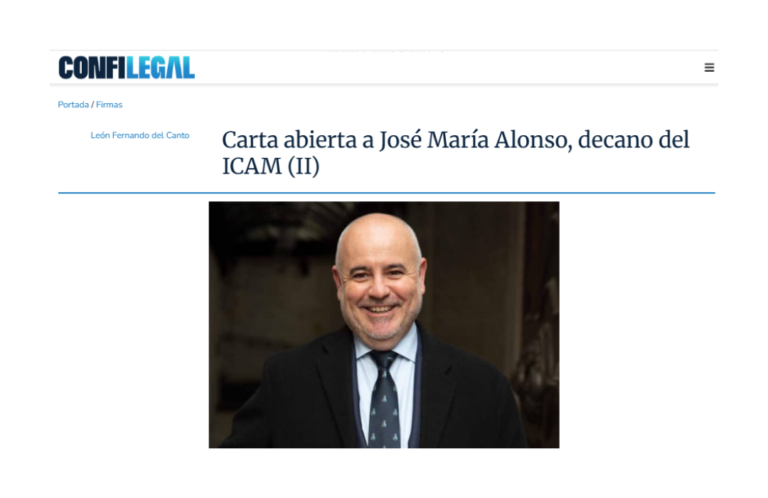
Open Letter to José María Alonso, Dean of ICAM (Part II)
The legal profession thrives on clarity, accountability and mutual respect — between its members, and between those who represent them and the community at large. In this spirit, I write again to you, Dean, as a colleague and fellow member of the legal profession, to propose a framework for how we can engage constructively on matters of professional governance and institutional integrity.
Throughout our profession, there is growing concern among practitioners about bureaucratic inertia and procedural delay. When communication becomes slow or opaque, confidence in our institutions diminishes. This letter sets out a clear set of principles that should guide any meaningful exchange between a representative body and the lawyers it serves.
A Proposed Protocol for Engagement
To foster constructive dialogue, I propose the following principles:
Respond honestly and promptly to legitimate requests for information or clarification.
Seek clarification directly whenever a question is unclear, instead of allowing ambiguity to persist.
Maintain full transparency of financial and contractual information that is relevant to our profession and to members who contribute to the institution.
Avoid procedural delays that serve no legitimate purpose and only reinforce perceptions of obfuscation.
Where possible, leverage public communication channels to reduce misunderstandings and promote openness — particularly when the subject matter is of legitimate public interest.
These principles are not abstract ideals; they are practical guidelines for professional governance that reinforce trust and accountability.
The Need for Meaningful Replies
In recent communications, the responses received have not adequately addressed the substantive concerns raised, and in some instances have generated more confusion than clarity. Effective communication requires addressing the substance of the questions, not merely offering partial answers or formal observations that fail to clarify the underlying issues.
Furthermore, it is crucial that the recipient of a request understands the context and authorship of the inquiry. For a professional representative body to respond without confirming basic details — such as the identity of the correspondent or the authority under which the request is made — undermines confidence in the process.
Key Questions Still Awaiting Clear Answers
To ensure that this dialogue advances rather than stagnates, the following points must be addressed with directness and specificity:
Contracting Policies and Oversight: What are the documented policies and internal audit mechanisms governing the award of external service contracts? If no such policies exist, it should be stated unequivocally.
Application of Public Procurement Principles: Please explain why, in practice, a public-law corporation such as ours has not fully adopted the principles of transparency and public procurement legislation that would enhance governance and accountability.
Conflict of Interest Clarification: Is there, or is there not, a conflict of interest arising from recent professional relationships? If so, please explain the nature and extent of those relationships.
Employee and Contractor Disclosure: In addition to the existing register of employees, please provide a comprehensive list of paid contractors whose remunerations exceed €60,000 annually, subject to applicable data protection obligations.
Addressing these questions directly and transparently is not merely an administrative task — it is a professional imperative that reinforces trust across the profession.
A Constructive Path Forward
To achieve meaningful progress, engagement must be purposeful, transparent and collegial. Should you prefer to delegate responses, it is appropriate to do so through a member of the governing board or authorised officer, and ideally through a representative who demonstrates independence and credibility.
Ultimately, the goal is not confrontation, but institutional improvement — enhancing governance practices, strengthening accountability mechanisms and ensuring that representative bodies reflect the trust and confidence of the lawyers they serve.
At DelCanto, we uphold the values of professional integrity, transparency and constructive dialogue as essential to the legitimacy and future of the legal profession.